
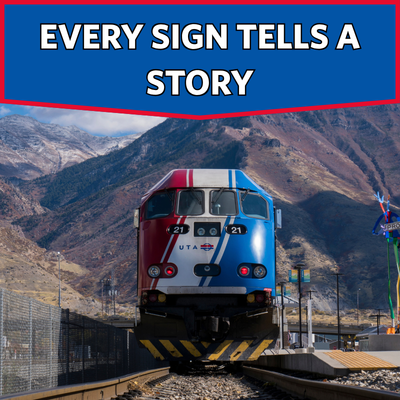
You know him as the Voice of the Utah Jazz, but that’s not why we wanted to talk to Craig Bolerjack. He’s also on the Board of Directors for Utah Operation Lifesaver, a position he feels passionately about because of how rail safety has impacted his personal life.
When Craig was 9 years old, his grandmother was killed in a tragic rail accident. Watch the video below to hear Craig tell his own story and share why rail safety awareness is important to him.
Craig’s story reminds us safety is real, safety comes first, and safety is a shared responsibility. It belongs to drivers who stop for crossing arms, to bystanders who speak up, and to us at UTA who invest in safety and security measures across the system. Craig's story is a reminder of why that shared responsibility matters and why UTA takes it seriously.
Every crossing gate, every painted line, every flashing light, and every rail crossing sign exists because of a story like this. That's why we reinforce simple actions that make a real difference, like looking both ways, respecting signals, and never stopping on the tracks.
Programs like See Something? Say Something! are part of that shared effort to keep everyone safe. If you see something concerning while riding UTA or around the transit system, report it:
- Call UTA Police Dispatch: 801-287-EYES (3937)
- Text UTA Police: Text 274-637 (CRIMES). Start your message with UTATIP, followed by your message.
- Call 911: If there is an immediate emergency or danger, call 911.
If you or someone you know is experiencing a mental health, suicide, or substance use crisis, call or text 988 to connect with the 988 Suicide & Crisis Lifeline.
Not every close call and every safety story ends the same way, and that's exactly why UTA created the Trains Don't Swerve series. These videos ask us to look closely at moments that almost were: real-life close calls, caught on our security cameras, where a different choice in a single second could have changed everything.
Trains do not swerve. They can't stop on a dime, change direction, or see around a curve in time to save someone who steps into their path. The average freight train traveling 55 mph will take over a mile — the length of 18 football fields — to stop. That means the responsibility has to belong to the rest of us. Trains Don’t Swerve exists to walk through those real moments and ask what could have gone differently, and what would you do?
Click here to explore our playlist of Trains Don’t Swerve videos.
This week, and always, we ask that you carry these stories with you. In the words of Craig Bolerjack, “It’s just one little mistake that can cost a life and impact a family.”
Pay attention, look out for each other, and know that the choices you make write more stories than just your own.
We Move Safety.
We Move You.